Artificial intelligence has quietly become the most-used “counsellor” for Indian students applying abroad. According to a Leap Scholar year-end report analysing over 3 million students, 75% of Indian students now use AI tools like ChatGPT to shape their study-abroad decisions — from shortlisting universities to weighing scholarships and post-study visa options.
But here’s the catch: the same AI tools that make applications faster are also the reason universities have completely rewritten their admissions rules in 2026. Get the balance wrong, and a tool meant to help you could actually cost you your seat.
This guide breaks down exactly how AI tools for college applications are being used on both sides of the admissions desk — by students and by universities — and what Indian applicants specifically need to watch out for before their next submission.
How Indian Students Are Actually Using AI in Applications
Table of Contents
AI has moved well beyond “help me write an essay.” Indian applicants are using it across the entire admissions journey:
- University shortlisting — comparing affordability, scholarships, and post-study work visa rules across countries in minutes instead of weeks
- SOP (Statement of Purpose) drafting and editing — brainstorming structure, tightening language, and catching grammar errors
- Scholarship matching — tools that scan a student’s profile against thousands of scholarship databases automatically
- Interview preparation — practising mock interview questions with AI chatbots before the real thing
Interestingly, cost and affordability now rank as the top decision factor for 75% of Indian students, followed by scholarships (70%) and career advancement (58%) — with traditional metrics like university rankings dropping out of the top five priorities altogether. AI-powered dashboards are a big reason for that shift, since they surface real cost-of-study and ROI data that used to require hours of manual research.
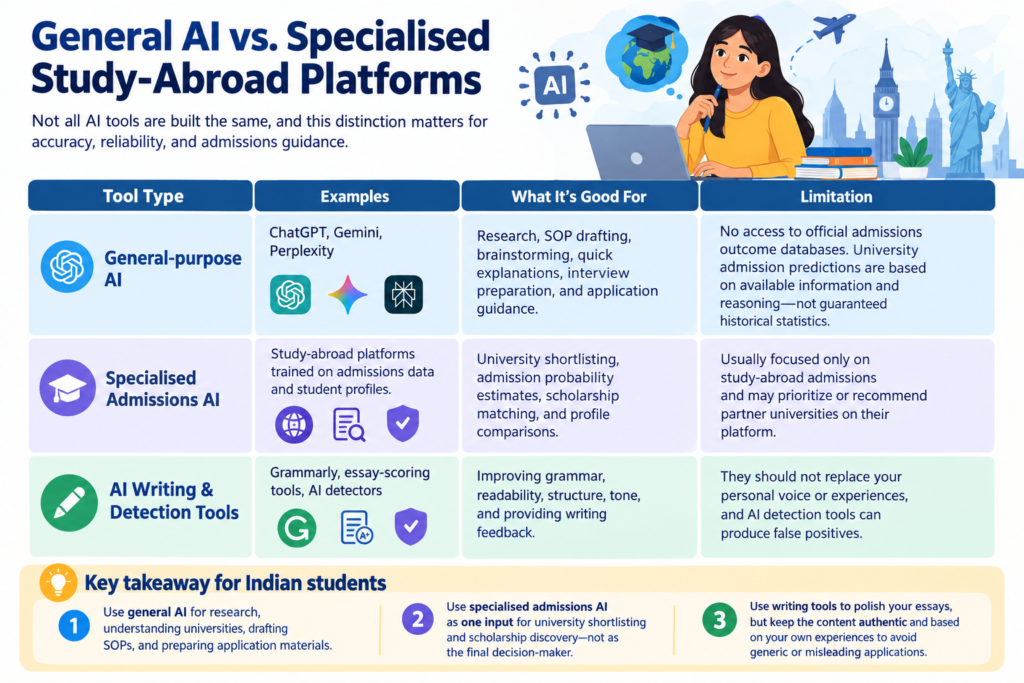
General AI vs. Specialised Study-Abroad Platforms
Not all AI tools are built the same, and this distinction matters for accuracy:
| Tool Type | Examples | What It’s Good For | Limitation |
|---|---|---|---|
| General-purpose AI | ChatGPT, Gemini, Perplexity | Research, SOP drafting, brainstorming, quick explanations | No access to real admissions outcome data — predictions are guesses, not statistics |
| Specialised admissions AI | Study-abroad platforms trained on historical data | University shortlisting, admission-probability estimates, scholarship matching | Narrower scope; may push partner universities |
| AI writing/detection tools | Grammarly, essay-scoring bots | Polishing grammar, structure feedback | Not a substitute for your own voice; can trigger false AI-flagging |
General AI tools are trained on publicly available information, while dedicated admissions platforms are trained on actual historical outcomes — which is why serious applicants often use both: general AI for drafting and research, specialised platforms for probability and shortlisting decisions.
How Universities Are Responding to AI — And Why It Matters for You
This is the part most Indian students applying abroad underestimate. Universities didn’t just notice AI-written essays — they restructured entire evaluation processes because of it.
1. AI Policies Now Vary Wildly by University
There’s no single global rule. Some examples from the current 2026-27 application cycle:
- Brown University and Georgetown prohibit AI use in applications entirely, with Georgetown warning it can rescind admission if AI-generated content is discovered later.
- UVA (University of Virginia) allows limited use — brainstorming and grammar checks only, not content generation.
- Caltech takes a disclosure-based approach, asking applicants to declare how they used AI rather than banning it outright.
- Many universities have no explicit written AI policy at all, which is arguably riskier — you’re expected to use judgement without clear guardrails.
Before you use any AI tool for an application essay, check that specific university’s AI policy page — usually found under “Applying,” “Essay Prompts,” or the academic integrity statement. Assuming one school’s rules apply everywhere is one of the most common mistakes applicants make.
2. Admissions Offices Are Actively Watching for Homogenised Writing
A review of tens of thousands of admissions essays at a selective U.S. college found a rise in homogeneous, generic-sounding language after AI tools became widely available — and admissions readers are now trained to spot it. One analysis found that 47% of AI-assisted essays opened with a generic, formulaic first line that purpose-built admissions-review tools are specifically designed to flag.
3. The False-Positive Risk Is Especially High for Indian (Non-Native English) Applicants
This is the single most important point for Indian students to understand: AI-detection tools are unreliable, and they disproportionately misflag non-native English writers.
One study found that 61% of TOEFL essays written by non-native English speakers were incorrectly classified as AI-generated by detection software — prompting some universities to disable detection tools altogether because of the false-positive risk. If your natural English phrasing (shaped by Indian English conventions, translation patterns, or formal schooling style) reads as “unusual” to a detector, you could be flagged even if you wrote every word yourself.
What this means practically: write in your authentic voice rather than over-polishing every sentence into flawless, AI-smoothed English — ironically, too-perfect writing can look more suspicious to detection software than genuinely personal, slightly imperfect prose.
What’s Acceptable AI Use vs. What Crosses the Line
Admissions offices increasingly draw this same distinction, regardless of individual policy wording:
Generally Acceptable:
- Brainstorming essay topics or angles
- Checking grammar and spelling
- Getting feedback on structure or clarity
- Researching universities, scholarships, and visa requirements
- Practising interview questions
Risky or Prohibited at Most Universities:
- Asking AI to generate full essay drafts you then submit
- Letting AI “improve” your voice until it no longer sounds like you
- Using AI to write recommendation letters or SOPs wholesale
- Failing to disclose AI use where a university explicitly requires it
The safest mental model: AI as a support tool is fine almost everywhere; AI as a ghostwriter is fraud almost everywhere. The line isn’t about whether you used AI — it’s about whether the final words, ideas, and voice are genuinely yours.
Pro Tips for Indian Students Using AI in Applications
- Read each university’s AI policy individually — don’t assume Ivy League rules apply to your target Canadian, Australian, or European universities, or vice versa.
- Use AI early, human-edit late. Use tools for brainstorming and structure in the first draft, then rewrite in your own natural voice for the final submission.
- Don’t let AI erase your personal/cultural specificity. Details about your school, city, family business, or a very India-specific experience are exactly what make an essay stand out — generic AI phrasing tends to strip these out.
- Cross-check scholarship and visa information AI gives you against the official university or government source — general AI tools can be outdated or simply wrong on fast-changing visa rules.
- Keep a record of your drafts. If a university asks you to disclose AI use, having your own earlier, human-written drafts protects you if your final essay is ever questioned.
Common Myths About AI and College Applications
- Myth: “All universities ban AI use.” Reality: Policies range from total bans (Brown, Georgetown) to disclosure-based systems (Caltech) to no policy at all — you must check individually.
- Myth: “If I didn’t use AI, I have nothing to worry about.” Reality: Detection tools have a documented false-positive problem, especially for non-native English writers — a genuinely human essay can still get flagged.
- Myth: “Using AI guarantees a better shortlist of universities.” Reality: General AI tools lack access to real admissions outcome data — always cross-check big decisions with official sources or specialised, data-backed platforms.
Final Thoughts
AI isn’t going away from college applications — and for Indian students juggling shortlisting, SOPs, scholarships, and visa research all at once, it’s a genuinely useful accelerant when used correctly. The students who get into trouble aren’t the ones who use AI — they’re the ones who let it write their story for them instead of helping them tell it.
Use AI to move faster. Use your own voice to actually get in.
Frequently Asked Questions (FAQs)
1. Can Indian students use AI tools like ChatGPT for college applications? Yes, but how you use it matters. Most universities allow AI for brainstorming, research, and grammar checks, but not for generating full essay content you submit as your own.
2. Do all universities have the same AI policy? No. Policies vary widely — some universities ban AI entirely, others allow limited use with disclosure, and many have no explicit written policy at all.
3. Can AI-detection tools wrongly flag my essay even if I wrote it myself? Yes. Studies show detection tools can misclassify essays from non-native English speakers as AI-generated at high rates, which is a particular risk for Indian applicants.
4. Will using AI to brainstorm my SOP get me rejected? Generally no — brainstorming and outlining are considered acceptable use at most universities. The risk comes from submitting AI-generated content as your final, original work.
5. Are specialised AI study-abroad platforms more reliable than ChatGPT? For university shortlisting and admission-probability estimates, yes — they’re trained on real historical outcomes, whereas general AI tools rely on publicly available information only.
6. What’s the safest way to use AI for my SOP? Use it to organise your thoughts and get structural feedback, then rewrite the essay yourself in your own voice before submitting.
7. Do universities require me to disclose AI use? Some do — Caltech, for example, asks applicants to disclose how they used AI. Always check the specific university’s policy before applying.
8. Can AI help me find scholarships as an Indian student? Yes, several AI-powered platforms automatically match student profiles against scholarship databases, saving significant research time.
9. Is it true university rankings matter less to Indian students now? According to recent survey data, yes — affordability and scholarships now outrank university prestige as the top decision factors for most Indian applicants.
10. What happens if a university finds out I used AI against their policy? Consequences vary by school but can include application rejection or, in serious cases like Georgetown’s stated policy, rescinding an admission offer after the fact.
Sharing is Caring 🙂